
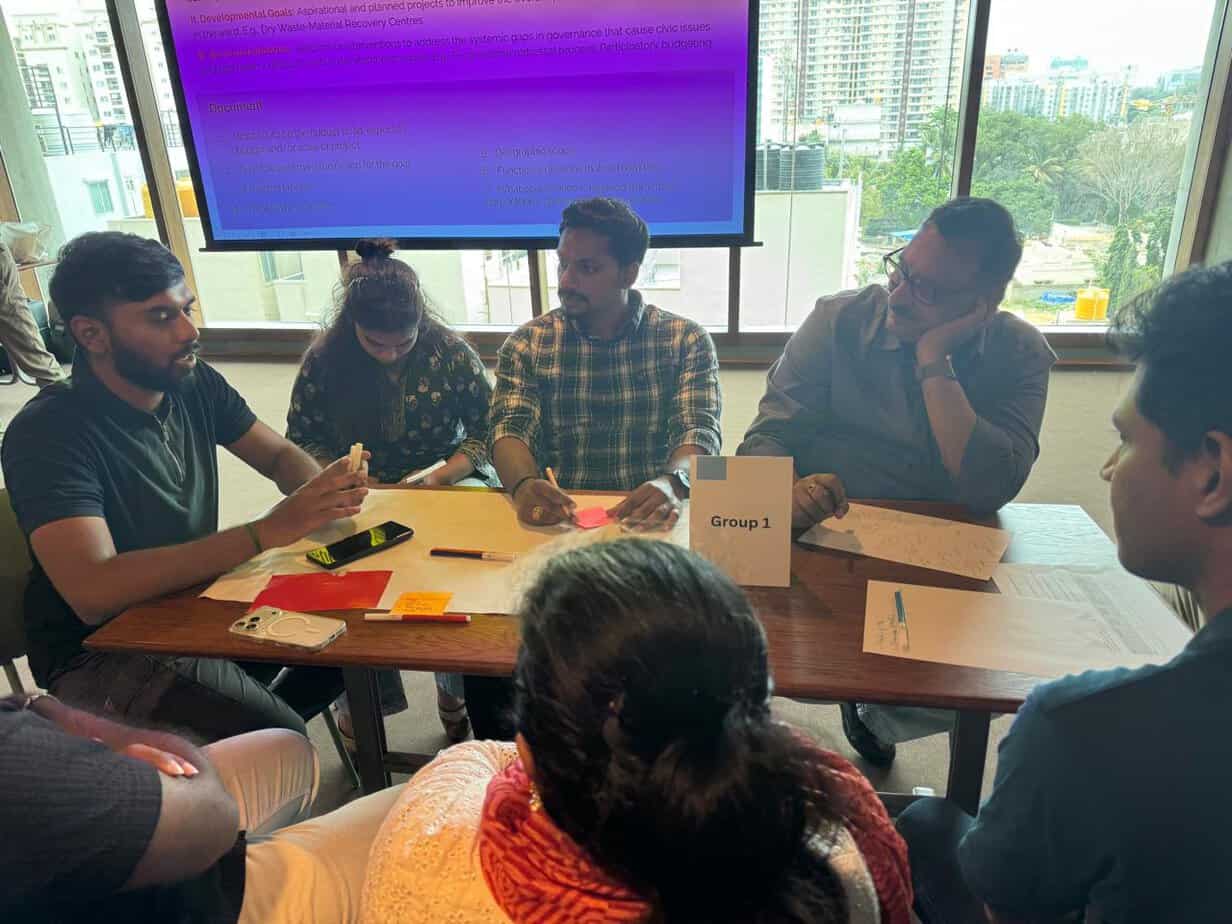
As Bengaluru prepares for elections to its newly constituted city corporations, citizens have an opportunity to do more than cast their vote–they can actively shape how their neighbourhoods are governed. It was with this objective that Oorvani Foundation, in collaboration with Janaagraha, Greater Bengaluru Balaga, Bangalore Apartments’ Federation (BAF) and Million Voters Rising (MVR), organised a Citizens’ Manifesto Jam for the Bengaluru East City Corporation (BECC) on 18 July 2026 at The *spark | pullur Centre, Whitefield.
The Jam brought together around 25 participants. It included resident welfare association members, civic volunteers, community leaders and engaged citizens from across BECC(Bengaluru East City Corporation). They were asked to collectively identify the priorities they believe should form part of a citizens’ manifesto – a comprehensive document that reflects the key issues, structural and developmental goals for their respective wards.
The idea of the jam stems from citizens’ call for better local governance. One of the most foundational ways of addressing this is to provide citizens themselves with opportunities to understand how city governance works and to articulate informed, actionable priorities. Before the event, participants received a set of pre-jam reading materials introducing the roles and responsibilities of corporators, ward governance, the BECC budget, the delineated ward boundaries of the new GBA, some key civic datasets, and a structured template for documenting their ward-level issues and goals. This enabled discussions to move beyond individual grievances and towards collective deliberation on the future of Bengaluru East.
The Jam began with a brief introduction by Vandana from Oorvani, followed by a detailed explanation of the event and its goals by Vikram from Oorvani. Participants were also briefed about the new GBA structure by Kochu Sankar, an active citizen in Bengaluru East. Vivekanand from Janaagraha then briefed the participants about the objective of the citizens’ manifesto series.
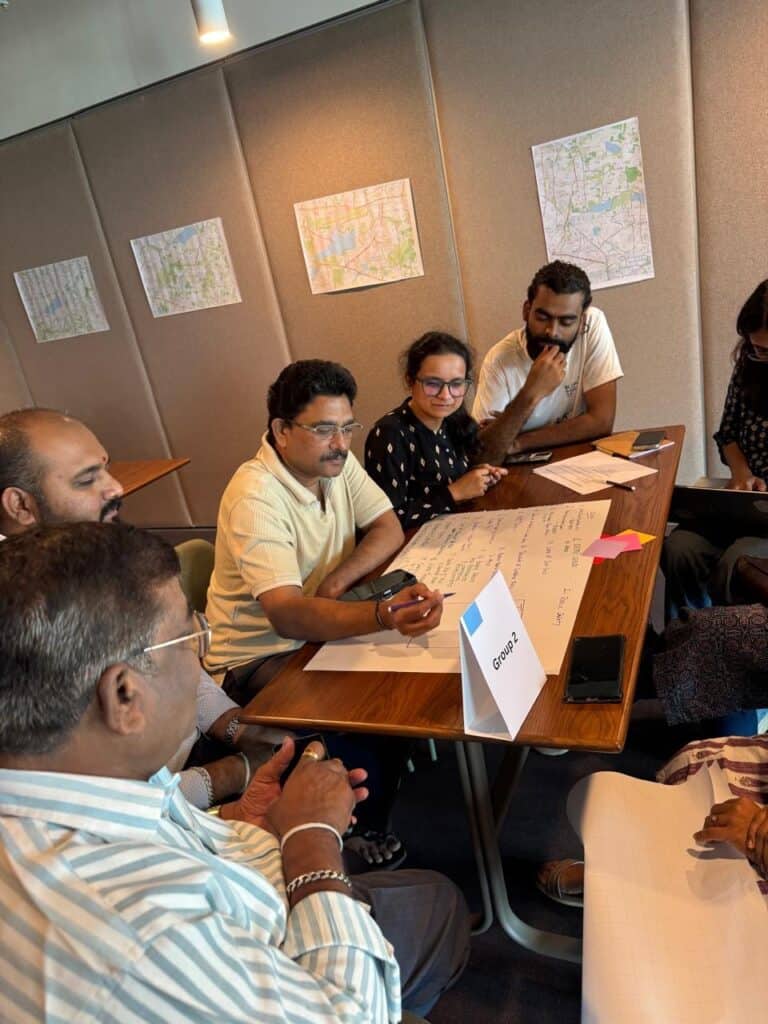
Participants were then divided into four facilitated groups, each comprising residents from a cluster of wards within BECC. Rather than focusing on isolated neighbourhood issues, the discussions encouraged participants to identify common challenges, understand their underlying causes, and imagine the kind of governance needed to address them.
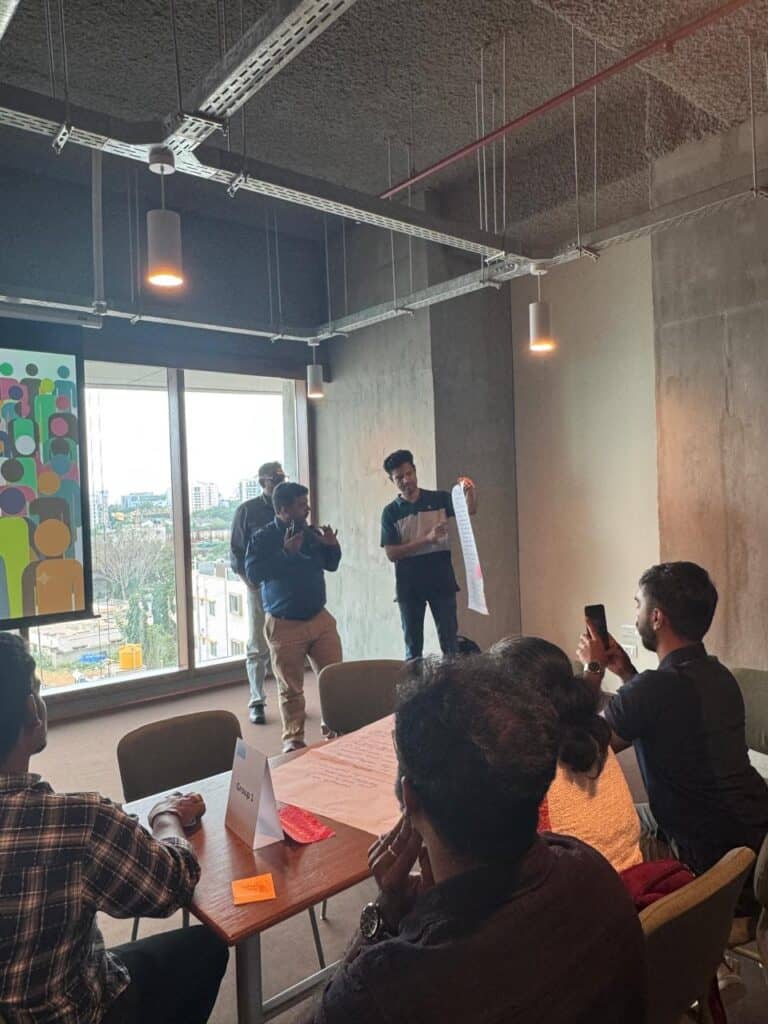
Each facilitated group produced 4-5 key priorities for their respective cluster of wards, categorised as civic issues, developmental goals, or structural reforms. Participants within the group had to deliberate on the nature of the issue, the root cause, propose solutions, identify departments responsible and the coordination required, scale, time period, and an indicative budget where applicable. After the deliberation, all four groups presented their civic priorities to the entire Jam audience, which was opened up to questions, suggestions, and further discussion.
Looking beyond individual civic problems
Roads, mobility and basic infrastructure emerged as recurring concerns across all four groups. Participants spoke about roads that are repeatedly dug up by different utility agencies with little coordination, disappearing footpaths, traffic congestion, poor last-mile connectivity and inadequate planning for rapidly growing neighbourhoods. One group pointed to the ITPL–Pattandur Agrahara corridor, where rapid growth in apartments and gated communities has far outpaced the supporting infrastructure, leaving roads, drainage systems and public amenities under immense strain.
The discussions repeatedly returned to a common conclusion that many infrastructure problems are symptoms of fragmented governance. Participants suggested appointing nodal officers to coordinate departments, making contractor information publicly available, and introducing standard operating procedures before roads are cut for utility works so that newly laid roads are not repeatedly damaged.
Reimagining public spaces and neighbourhoods
Participants also emphasised that a liveable city needs more than roads. Across several wards, lakes, rajakaluves (storm water drains), parks and playgrounds were seen as essential public spaces that deserve better protection and maintenance.
One discussion highlighted how Gunjur, despite having five lakes and two playgrounds, continues to see neglect of rajakaluves and public spaces, while participants from Channasandra pointed out the near absence of accessible public parks despite extensive private development. Another concern was the increasing use of parks and playgrounds for political and religious events, reducing their availability for neighbourhood residents.
Rather than viewing lakes only as water bodies, participants imagined them as vibrant public spaces that could strengthen both ecological resilience and community life. Moreover, rajakaluves, while functioning as storm water drains to reduce flooding, were also reimagined as a potential public place for leisure activities.
Governance as a real issue in Bengaluru East
Perhaps the strongest insight from the workshop was that citizens did not see roads, waste or flooding as isolated problems. Across all four groups, participants identified weak enforcement, fragmented institutional responsibilities, lack of transparency and poor coordination as the root causes behind many civic failures.
Several practical suggestions reflected this thinking: a citizen-facing dashboard to track ward budgets, civic works and grievances; regular ward committee meetings focused on planning rather than just complaints; greater transparency about contractors and ongoing projects; and making civic data publicly available for citizen audits. Participants also called for stronger enforcement of building regulations, noting that unplanned development has placed enormous pressure on existing infrastructure in several parts of Bengaluru East.
Beyond electing: the role of citizens in governance
The workshop also highlighted inspiring examples of citizen action already underway. A participant from Kundanahalli described how an umbrella association representing around 1,500 families had collectively funded improvements to local footpaths and roads and also hired ‘street managers’ to monitor public spaces and report issues for quicker action. Participants acknowledged that while such initiatives demonstrate remarkable civic commitment, they cannot substitute for accountable public institutions or be replicated everywhere.
The Citizens’ Manifesto Jam marked the beginning of a collaborative process to identify shared priorities that can inform election conversations and strengthen accountability long after the elections are over. More importantly, the jam demonstrated that when citizens are equipped with the right information and given a structured space to deliberate, the conversation moves beyond complaints. While individuals can raise grievances on their own, this event allowed them to think collectively about the future of their neighbourhoods and share responsibility over the kind of city they want to build together.